Why Puzzles Are Secretly One of the Best Things for an Anxious Mind
Puzzles give an anxious brain somewhere calm to land. Here is the science behind why word searches and other puzzles reduce anxiety — and when to use them.
There is a particular kind of mental exhaustion that comes not from doing too much, but from thinking too much. The kind where your brain is technically at rest — you're not working, not solving anything — but it refuses to actually stop. Replaying conversations. Running through tomorrow. Circling the same worry for the fourth time that hour.
Most advice for this involves breathing exercises, journaling, or meditation. All of which are genuinely useful. But there is a simpler, more accessible tool that often gets overlooked: puzzles.
---
What Puzzles Do to an Anxious Brain
Anxiety, in its most common form, is the mind running on future-oriented thinking — anticipating threats, planning for worst cases, catastrophising outcomes that may never happen. The brain's default mode network is overactive, and it keeps pulling your attention away from the present moment and back into the loop.
Puzzles interrupt that loop by giving your brain a specific, bounded task to focus on. Word searches, crosswords, jigsaw puzzles — they all require just enough cognitive engagement to occupy the part of your mind that would otherwise be spiralling, without demanding so much that they become stressful.
Researchers call this state attentional absorption — a mild form of flow where you're focused enough to be present but relaxed enough to let the nervous system settle. It is, in many ways, the same mechanism that makes meditation work. Except it requires no training, no special posture, and no tolerance for sitting in silence.
The Screen Problem
Most of us reach for our phones when we want to switch off. The problem is that phones don't actually switch the mind off — they just redirect it. Scrolling social media, checking news, watching short videos — all of these are passive-input activities that keep your nervous system in a low-grade alert state. The light, the unpredictability, the infinite scroll — none of it signals safety to your brain.
Physical puzzles do the opposite. There is no algorithm deciding what comes next. No notifications. No comparison. Just a pen, a page, and the quiet satisfaction of finding a word you'd been scanning for.
That shift from screen to page — especially in the hours before bed — has a measurable effect on both sleep quality and anxiety levels. Your brain gets the message that the day is winding down.
Advertisement
Mindfulness Without Meditation
One of the barriers people encounter with traditional mindfulness practice is that it asks you to do nothing — and for an anxious mind, doing nothing feels like giving anxiety more room to move in. The mind wanders. The practice feels like failing.
Puzzles offer a different entry point. You are doing something, which satisfies the part of your brain that needs to be occupied. But what you're doing is calm, repetitive, and gently absorbing — which satisfies the part of your nervous system that needs to slow down.
Many puzzle books now include mindful prompts or intentions alongside the puzzles — a brief phrase or reflection designed to anchor you in the present moment before you begin. The combination of a grounding thought and a focused activity creates something close to a mindfulness session without requiring you to sit in silence.
When to Use Puzzles for Anxiety
Evening wind-down: Replacing 30 minutes of scrolling with a puzzle before bed can significantly improve sleep onset. The focused but calm activity helps the nervous system transition out of alert mode.
Anxious waiting: Appointments, commutes, situations where anxiety tends to spike in idle moments — having a puzzle book in your bag is a simple, effective interruption.
Difficult days: When everything feels heavy and focus is impossible, a word search asks very little of you. You just look for words. There is something quietly restorative about finding them.
As a daily ritual: Some people find that a puzzle with morning coffee sets a calmer tone for the day — a small act of presence before the demands arrive.
A Recommendation Worth Making
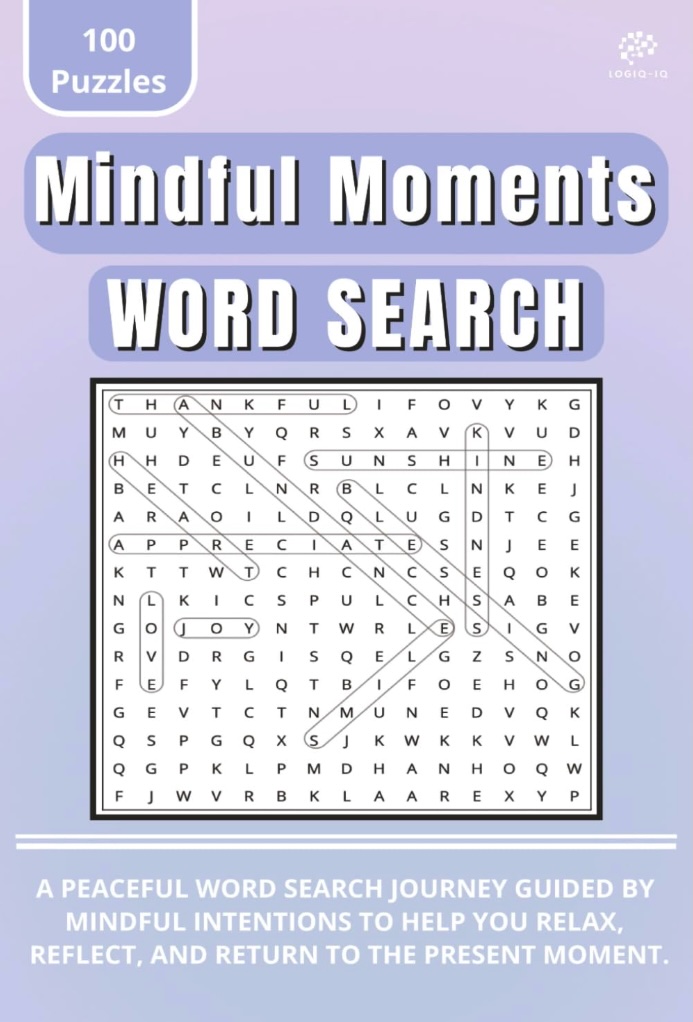
If you want to try this approach, the book below pairs word search puzzles with gentle mindful intentions — a brief grounding phrase before each puzzle to anchor your attention and set a calm tone. Large print, clean design, no clutter. It is the kind of book you can keep on your nightstand and reach for instead of your phone.
It won't solve anxiety. Nothing solves anxiety in a single sitting. But it gives your mind somewhere calm to land — and sometimes, that is exactly what you need.
The Broader Point
Anxiety management does not have to be complicated. Breathwork, journaling, therapy, exercise — these are all valuable, and we cover them across this site. But the tools that get used are often the simple ones. The ones that ask very little of you and give something back quietly.
A puzzle is a low-stakes act of presence. It asks your mind to be here, focused on this, for a few minutes. In a world designed to pull your attention in seventeen directions at once, that is not a small thing.
If you are looking for more ways to build calm into your day, the [evening routine guide](/blog/the-evening-routine-that-helps-you-sleep) and the [anxiety cycle article](/blog/how-to-break-the-anxiety-cycle-for-good) are good places to start. And if you want the app version of a daily check-in — something to help you track your mood and notice patterns over time — the [AuraBean app](https://aurabean.me/studio) is built for exactly that.
Recommended
Mindful Moments Word Search
by AuraBean Studio
Word search puzzles paired with calming mindful intentions. Large print, clean design — the ideal screen-free way to wind down and quiet an anxious mind.
View on Amazon →Medical disclaimer
This article is for educational and personal reflection purposes only. It is not a substitute for professional medical or mental health advice, diagnosis, or treatment. If you have any concerns about your health or wellbeing, please consult a qualified healthcare professional. In a crisis, contact your local emergency services or a mental health crisis line.
Explore these topics
Best picks
Shopping around this topic?
Best Weighted Blankets for Anxiety & Sleep (2026)
Weighted blankets use deep pressure stimulation to reduce cortisol and promote calm. We ranked the top options for anxiety relief and sleep quality — from budget picks to premium buys.
See the ranked list →
Best Yoga Mats — Eco & Organic Options (2026)
The right yoga mat transforms your practice. We ranked the top eco-friendly and natural rubber mats for grip, cushioning, and sustainability — from beginner-friendly to studio-grade.
See the ranked list →
Keep reading
More from the Journal
Weekly Wellbeing Note
Want the best new reads without checking back manually?
Get one thoughtful weekly email with our latest article, a useful recommendation, and one calm practice to try.
No spam. Unsubscribe anytime.
Track how you feel, day by day
Put what you've read into practice. Daily check-ins, mood patterns, breathing exercises, and guided journaling — all in the AuraBean Wellness app.
Not medical advice. Designed for reflection and self-awareness.